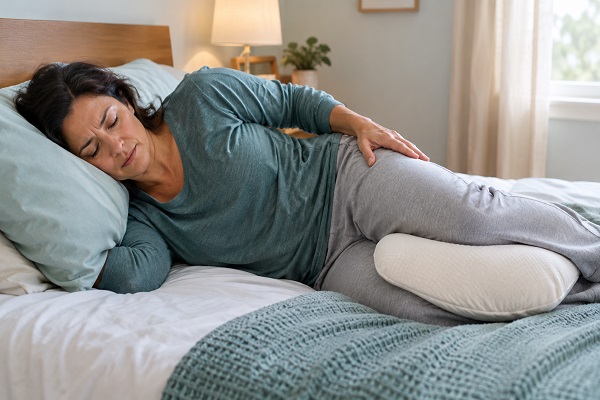
There was a stretch about two years ago when I couldn’t lie on my right side for more than ten minutes without waking up in a cold sweat. Not from a nightmare — from my own hip. That deep, achy, “someone is grinding sandpaper into my bone” feeling. If you’re dealing with fibromyalgia hip pain, you already know exactly the sensation I’m talking about, and you probably know it doesn’t show up on an X-ray no matter how many times you ask your doctor to check.
I’m not a physician. I’m just someone who’s spent a long time troubleshooting my own body, talked to a lot of other people in fibro support groups, and picked up a handful of things that genuinely made a difference. So take this as one patient sharing notes with another, not medical advice.
Why Fibromyalgia Hip Pain Feels So Different From “Normal” Hip Pain
The first thing that threw me off was how the pain moved around. One week it was my left hip, the next it had jumped to my lower back and thighs too. A regular hip injury — like a strained muscle or arthritis — usually stays put. Fibromyalgia hip pain doesn’t play by those rules.
What’s actually happening (as far as researchers currently understand it) is that fibromyalgia messes with how your nervous system processes pain signals. Your hip joint itself might be completely fine structurally, but your brain and spinal cord are amplifying normal signals into something that feels unbearable. That’s why two people can have identical MRIs and one is in agony while the other feels nothing.
I wasted almost a year assuming something was mechanically wrong with my hip. I went through physical therapy sessions where the therapist kept saying “your range of motion is actually really good,” which was confusing and honestly a little frustrating. It wasn’t until my rheumatologist connected the dots that I stopped chasing a structural fix for something that wasn’t structural.
The Mistakes I Made Early On
Mistake #1: Pushing through it like it was a normal workout injury. I used to think “no pain no gain” applied here too. It doesn’t. With fibromyalgia hip pain, overdoing activity often triggers a flare that can knock you out for days. I learned this the hard way after a hiking trip that left me barely able to walk for almost a week.
Mistake #2: Only using heat, never alternating with cold. I lived with a heating pad practically glued to my hip for months. Heat does help relax tight muscles around the joint, but I found that alternating — heat for 15-20 minutes, then a break, occasionally a cold pack during a sharper flare — worked better than heat alone.
Mistake #3: Sleeping in the wrong position without adjusting. Side sleeping puts direct pressure right on the hip that’s already sensitive. I didn’t think about this until a physical therapist pointed it out.
Mistake #4: Ignoring my mattress. This one sounds small but wasn’t. An old, sagging mattress made everything worse. Switching to a medium-firm memory foam mattress with a bit of hip cutout support genuinely reduced my morning stiffness.
What Actually Helped With My Fibromyalgia Hip Pain
Here’s the stuff that made a real, measurable difference — not overnight, but over weeks and months of consistency.
1. A pillow between the knees
Sounds too simple to matter, but it does. If you sleep on your side, put a firm pillow between your knees. It keeps your hips aligned instead of letting the top leg pull your pelvis out of position all night. I use a wedge-shaped knee pillow now instead of a regular one — it stays in place better.
2. Gentle, low-impact movement (not rest, not intense exercise)
Total rest made my hip stiffer. Intense exercise triggered flares. The sweet spot was gentle movement — short walks, water aerobics, or slow stretching. A physical therapist who specialized in chronic pain (not sports injuries) helped me build a very low-intensity routine. Water-based exercise in particular took a lot of pressure off my hip while still keeping it mobile.
3. Tracking my flares
I started using a simple app (I use Bearable, though there are several similar ones) to log pain levels, sleep, weather, and activity each day. After about six weeks of data, patterns showed up that I never noticed before — barometric pressure changes and poor sleep were bigger triggers for my fibromyalgia hip pain than I’d realized. That let me actually plan around bad-weather days instead of getting blindsided.
4. Warm baths with Epsom salt, timed right
Not as a miracle cure, but as a genuinely useful tool. A warm bath about an hour before bed loosened up the muscles around my hip enough that I fell asleep faster and didn’t wake up as often from pain.
5. Talking to a rheumatologist who actually specializes in fibromyalgia
This mattered more than almost anything else on this list. A general practitioner did their best, but a rheumatologist who deals with fibromyalgia regularly understood the nuances immediately and adjusted my treatment plan — including medication timing and low-dose options — in a way that made a real difference.
A Simple Step-by-Step Routine That Helped Me Manage Flare Days
- Start the morning slow. No jumping out of bed. A few gentle stretches while still lying down before standing up.
- Apply heat for 15-20 minutes if the hip feels stiff and achy that morning.
- Move for 10-15 minutes, even if it’s just walking around the house. Movement, not intensity, is the goal.
- Check in with pain levels using a tracking app, so you know if today is a “push a little” day or a “rest more” day.
- Use a knee pillow or hip-supportive position for any extended sitting or lying down.
- Evening bath or heat session before bed to help with sleep quality.
It’s not glamorous. It’s not a fix. But doing this consistently for a few months noticeably reduced how often my fibromyalgia hip pain flared into something severe.
Common Mistakes People Make (Beyond My Own)
- Assuming it’s arthritis and only treating it that way. Fibromyalgia hip pain often gets misdiagnosed early on, which delays the right treatment.
- Skipping sleep hygiene. Poor sleep and fibromyalgia pain feed into each other in a nasty loop. Fixing sleep is not optional, it’s foundational.
- Comparing your pain to someone else’s fibromyalgia experience. It varies wildly person to person. What works for one person’s hip pain might do nothing for yours.
- Avoiding all movement out of fear of a flare. This usually backfires and leads to more stiffness, not less.
- Not looping in a mental health professional. Chronic pain and anxiety or low mood often show up together, and addressing both sides genuinely helps the physical symptoms too.
Final Thoughts
If there’s one thing I wish someone had told me earlier, it’s that fibromyalgia hip pain isn’t something you “beat” in a dramatic before-and-after way. It’s more like learning to work with a difficult roommate — you figure out its patterns, you adjust your space around it, and slowly life gets more manageable even if the roommate never fully leaves.
Everyone’s body responds differently, so treat everything here as a starting point for a conversation with your own doctor, not a replacement for one. But if you’re in the thick of it right now, just know the constant hip pain doesn’t mean nothing will work — it usually just means you haven’t found your specific combination yet.
This article is based on personal experience and general information, not medical advice. Please talk to a qualified healthcare provider about your specific symptoms and treatment options.